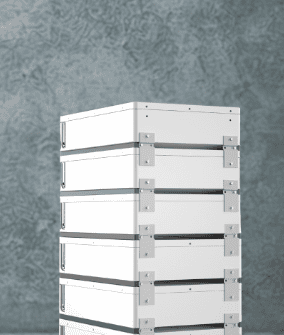
UZ Battery Storage guideline

11.23.25 2:21 PM - Comment(s) - By gavain.ren

When you visit this blog, my goal is to help you clearly understand everything about UZ batteries so you can make your own decisions with confidence. I aim to simplify the sales and installation process, explain the basic knowledge you need, and help you understand the key regulations. With this information, you won’t rely on complicated sales talk — you can decide for yourself what is best for your home.

About UZ

Founded in 2013, UZ has specialised in battery energy storage systems for more than a decade. As one of the few manufacturers consistently investing in long-term R&D, UZ provides reliable, efficient and high-performance storage solutions for residential, commercial and industrial applications.

UZ batteries are built using CATL core cell technology, delivering industry-leading safety, energy density and long-cycle performance. This ensures stable operation even under high-temperature and high-demand environments.

The company is also strategically funded by SES AI Corporation, a New York Stock Exchange–listed U.S. technology leader in lithium-metal batteries and AI-driven battery management systems. This partnership strengthens UZ’s capabilities in intelligent safety control, advanced battery management and future-focused energy technologies.

With strong technical foundations, rigorous quality systems and a mature global supply chain, UZ is committed to providing cost-effective, reliable, easy-to-install and easy-to-maintain battery storage products.
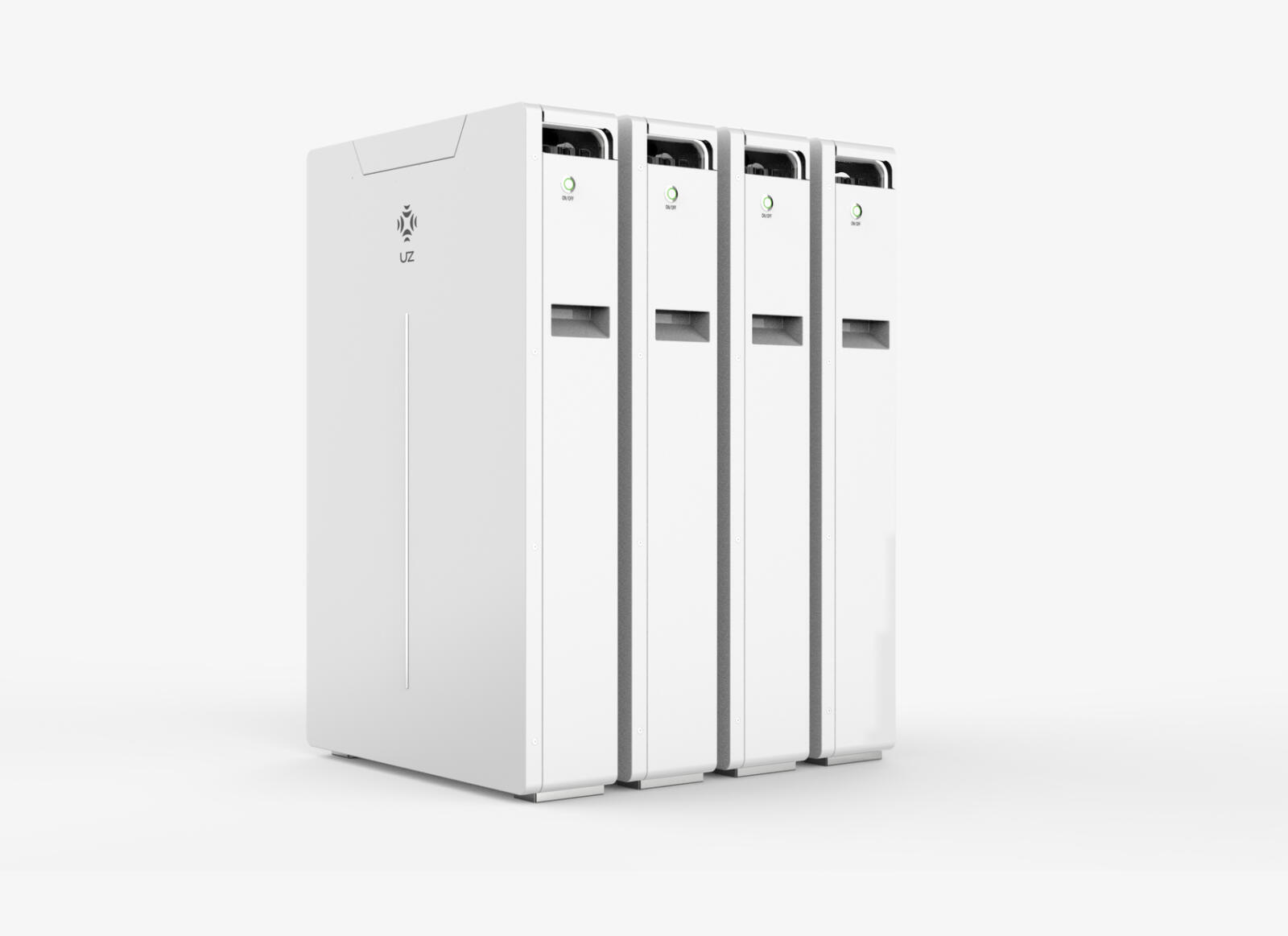
UZ battery Spec for Australian Homes

  • Model Number:PLPA-L1-10K2
  • Cell type:LiFePO₄
  • Capacity:10.24kWh
  • Operating Temperature : -5 °C--55°C
  • IP rating: IP65
  • Cycle: > 6000
  • Weights:94Kg
  • Dimensions (W x D x H): 550*165*876mm
  • Warranty: 10 years
  • Datasheet from here

Choose Your UZ Battery Package
30kWh battery powered by 5kW or 10kW Inverter
  • 1.  This package is the most affordable option for a small Australian family.

  • 2. If you choose a 5kW hybrid inverter, it will take around 6–8 hours to fully charge the battery.
    3.  Homes without large surge loads and with normal daily usage, the 5kW inverter is powerfull enough ;

  • 4. For this setup, we recommend having a 10kW solar system.If you already have a 6.6kW solar system, that is also fine—charging will just be slower.

  • 5.During winter, it is possible that the battery may not fully charge, and the daily capacity may be lower than your no-solar time usage. In this case, you can import electricity from the grid during off-peak hours to help reduce your costs.


  • 40kWh battery Powered by 5kW or 10kW hybrid Inverter
  • 1. This package is a battery capacity upgrade, for a small to medium-sized family, this is considered oversized, but it makes sense when you think about future electricity usage growth and the fact that the government rebate can only be claimed once per property.

  • 2. If you choose a 5kW hybrid inverter, it will take around 8–10 hours to fully charge the battery.In some cases, it may take almost two days to reach a full charge even you have no any consumption.

  • 3. If you choose a 10kW hybrid inverter, it will take around 4–5 hours to fully charge the battery, a larger inverter is always better for winter charging,for this setup, we recommend having a 10–20kW solar system.

  • 4. If you already have a 6.6kW system, that is still fine—charging will just be slower.

  • 5. During winter, the battery may not fully charge, and the daily usable capacity may be lower than your consumption during non-solar periods,in this situation, you can import electricity from the grid during off-peak hours to reduce your costs.

  • A large battery with a large inverter is always beneficial if you plan to join a VPP (Virtual Power Plant).(You can Google “VPP” to learn more.)


  • 50kWh battery Powered by 5kW or 10KW hybrid Inverter

  • see comments for " 40kWh battery powerd by 5kW or 10kW hybrid inverter"
  • Other options.

    Our standard package is designed to solve the most common needs for the majority of Australian homeowners, while keeping the overall budget highly affordable.If you have any special requirements, please speak directly with our sales team or email us — we will provide a customised solution for you.

    For example, our standard package may not be suitable if you need:
    • the battery relocated to a special position
    • support for heavy surge loads and go off-grid

    • faster charging or faster discharging
    • full-house backup
    • multiple energy sources working together (solar + wind + generator, etc.)

    In these cases, a customised system will be recommended.


    Self-check regulation

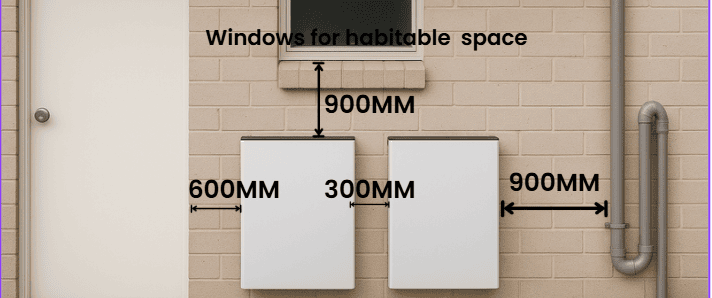
    Battery positioned near the wall with less than 300 mm separation

    PLease confirm:

  • The top of the battery must be at least 900 mm below the habitable-room window.

  • Clearance to the door must be at least 600 mm.

  • Clearance between the two batteries must be at least 300 mm.

  • Clearance to any water or gas pipe/device must be at least 900 mm.


  • Self-check regulation

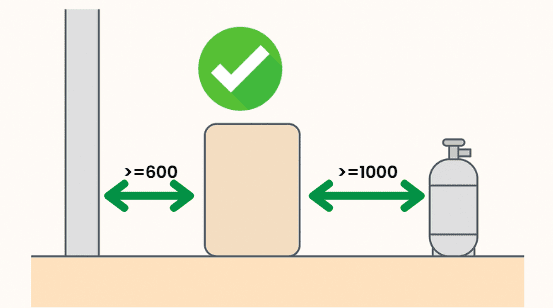
    Battery Installation With Separation From the House Wall


    No regulation applies when the battery is installed with:
    ≥600 mm separation from the house wall, and
    ≥900 mm separation from any gas facility or gas service equipment.

    Cable Path to the Switchboard Must Still Be Considered

    1. Underground cable path, or
    2. Wall-mounted cable path or

    3. in-air cable path.

    in the air.

    Stackup

    The battery will come out from the wall for generally 600mm

    Suitable for installation with separation from the wall as well.
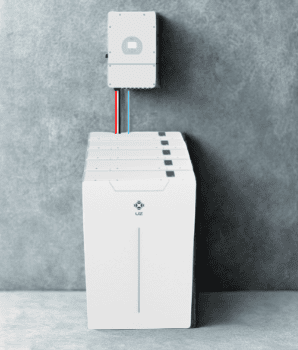
    Front forward

    the battery will come out from the wall for generally 1000mm

    Suitable for installation with separation from the wall as well.
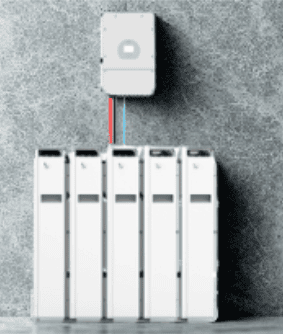

    Sideway forward 

    The battery will come out from the wall for generally 600mm

    Suitable for installation with separation from the wall as well.
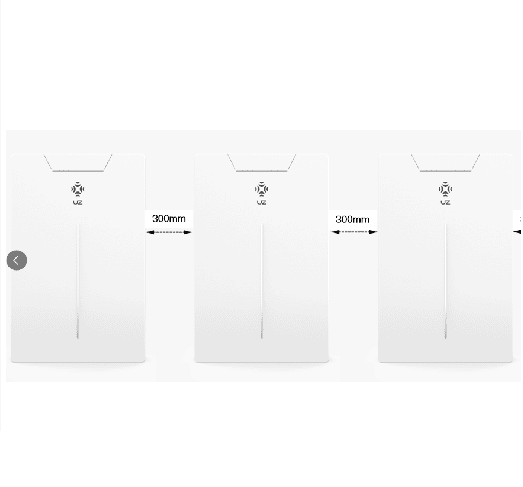
    Wall Mount

    Need a very long wall 

    Installation is limited to locations in close proximity to the main switchboard

    Our battery system can only be installed close to your main switchboard or sub-switchboard. If it is installed near a sub-switchboard, it can only back up the loads that are connected to that sub-switchboard. If you want the battery installed more than 10 metres away from your main switchboard or install in your garage, you will be surcharge for extra labor and material.

    Frequent Asked Questions

    What is the estimated payback period for my home battery system?

    If your regular electricity bill is between $100 and $200 per month, our goal is for the battery system to pay itself back within 3–4 years.

    How long the battery can be used?

    The battery comes with a 10-year warranty and a guaranteed minimum of 6,000 cycles. If you use roughly one cycle per day, the battery can realistically last around 16 years.

    why your battery is cheaper than others.
    1. Our battery is only slightly cheaper in materials compared to others.
    This is because we use a low-voltage battery solution, which is safer and requires fewer additional protection components.
    We also designed each battery module to be larger, which slightly reduces material and manufacturing costs.
    2. Our package appears much cheaper overall because we reduce installation and sales costs.
     The battery is designed to be very flexible to install, that's why we can limit your installation of battery  only around switchboard, which saves labour time and labour cost — a major part of your upfront expense. And instead of using high-cost salespeople for long demonstrations, we use this simple guide to help you make decisions, which also reduces the total package price.
    What inverter you use for your package?
    For single phase 
    • holymile  5KW and 10kW hybrid inverter. 
    • Deye 5KW and 10kW hybrid inverter.
    For 3 phase:
    Deye 5KW and 10kW hybrid inverter
    What inverter you use for your package?
    For single phase 
    • holymile  5KW and 10kW hybrid inverter. 
    • Deye 5KW and 10kW hybrid inverter.
    For 3 phase:
    Deye 5KW and 10kW hybrid inverter
    What is your system Warranty?
    1. For inverter 
    10-year full warranty
    2.for battery 
    10 year full warranty
    What about UZ branding
    UZ is not yet a big brand in Australia, but it has a strong global track record, It has proven its reliability worldwide and has been operating for more than 10 years.
    It is backed by SES AI (the founder), and the battery uses CATL cells internally — the same top-tier lithium manufacturer trusted by leading global brands.

    What Inverter you use?

    We mainly use Holymile inverters, which are our co-branded models. At the moment,  Holymile only offers single-phase and 2-phase inverters.

    For three-phase systems, we use Deye or APsystems inverters. Attached below are the datasheets:


    Is the UZ battery Safe?(Fire Rating)
    UZ uses a simple and proven low-voltage battery design, which is inherently safer.
    LV batteries operate at lower electrical voltage, meaning:
    • lower risk of electric shock
    • lower chance of arcs or sparks
    • easier protection and simpler safety systems
    This makes the system very safe for homes and everyday use.
    The battery has IP65 protection.

    This means it is:
    • fully dustproof
    • resistant to rain and water jets
    • suitable for outdoor installation in Australian weather


    What the advantage of LV(Low voltage)
  • Higher Safety
    Low-voltage (48V) systems are fully isolated from high-voltage risks. They greatly reduce the chance of electric shock, arc flash, or fire-up events, making them safer for homes and installers.

  • Lower Protection Requirements
    Because the voltage is low, installation requires fewer protective devices and simpler safety measures — reducing compliance pressure and minimizing complexity.

  • Lower Installation Cost
    Simpler wiring, no high-voltage PPE, and fewer safety components mean the overall installation cost is much cheaper.


  • Share -